Chronos BESS Configurations
Chronos supports three site configurations for battery assets. Each configuration has different physical components, efficiency/capacity constraints, and energy flow pathways.
Standalone Battery
The standalone battery consists of a site with one asset (a battery), connected to the system through two components:
- Storage Inverter — an inverter/rectifier pair, converts DC to AC and vice versa. Subject to both efficiency and capacity constraints.
- Grid Transformer — alters the AC voltage output from the storage inverter so power can flow to/from the grid. Subject to both efficiency and capacity constraints.
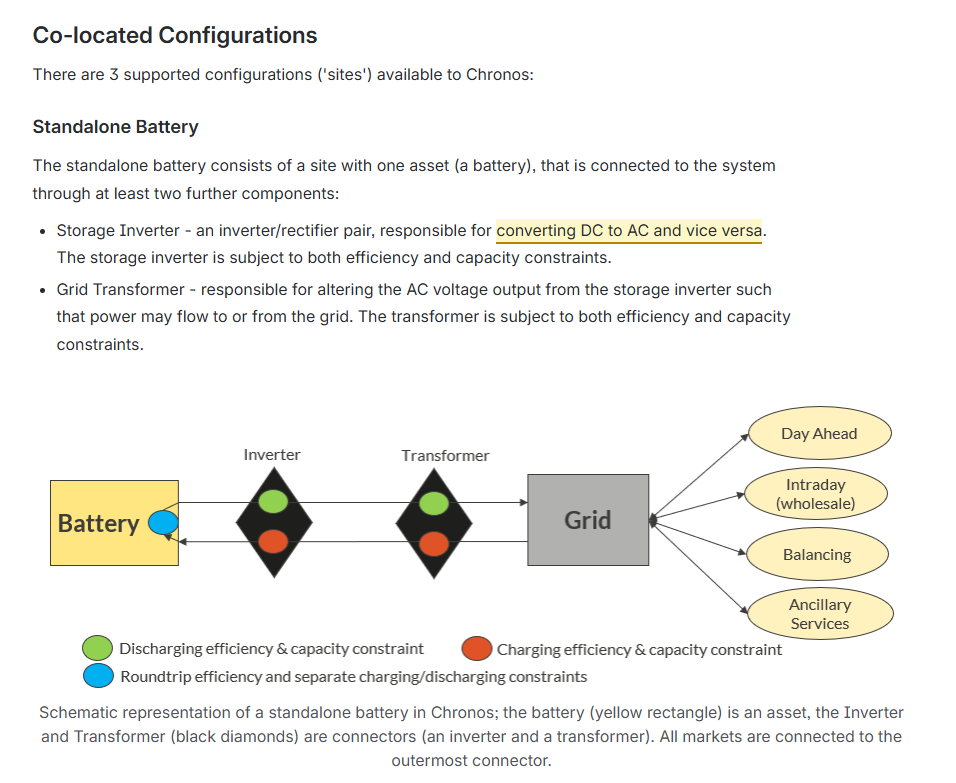
Battery (yellow rectangle) is the asset; Inverter and Transformer (black diamonds) are connectors. All markets connect to the outermost connector.
Constraints
| Battery | Storage Inverter | Grid Transformer | |
|---|---|---|---|
| Capacity constraints | Maximum Import Capacity, Maximum Export Capacity, Utilisation* | Maximum Import Capacity, Maximum Export Capacity | Maximum Import Capacity, Maximum Export Capacity |
| Efficiency factors | DC roundtrip efficiency | Import Efficiency, Export Efficiency | Import Efficiency, Export Efficiency |
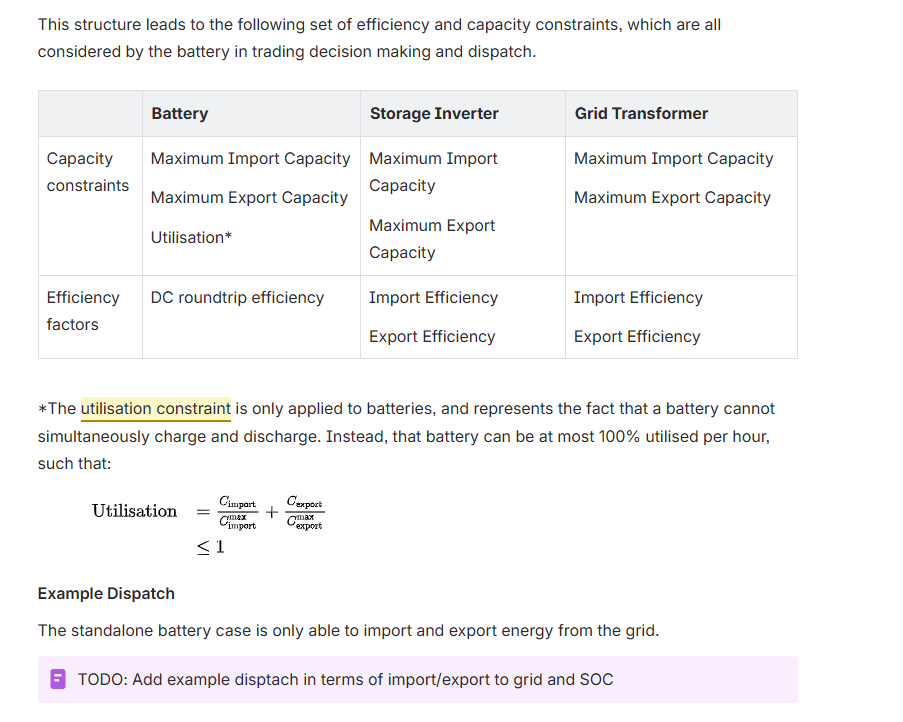
Utilisation constraint* applies only to batteries, representing that a battery cannot simultaneously charge and discharge. The battery can be at most 100% utilised per hour:
Utilisation = (C_import / C_max_import) + (C_export / C_max_export) ≤ 1
Example Dispatch: The standalone battery can only import and export energy from the grid.
AC-Coupled Co-located Asset
The AC-coupled battery consists of a site with two assets (a battery and a RES asset), each with its own inverter. Any charging of the battery by the RES must pass through both inverters (as well as the switch).
Components:
- Storage Inverter — an inverter/rectifier pair for the battery. Subject to both efficiency and capacity constraints.
- Res Inverter — a single inverter (or transformer), converts DC to AC (or adjusts AC frequency). Subject to both efficiency and capacity constraints.
- Grid Transformer — alters the AC voltage output so power can flow to/from the grid. Subject to both efficiency and capacity constraints.
- Switch — applies charging constraints (no grid charging / no RES charging).
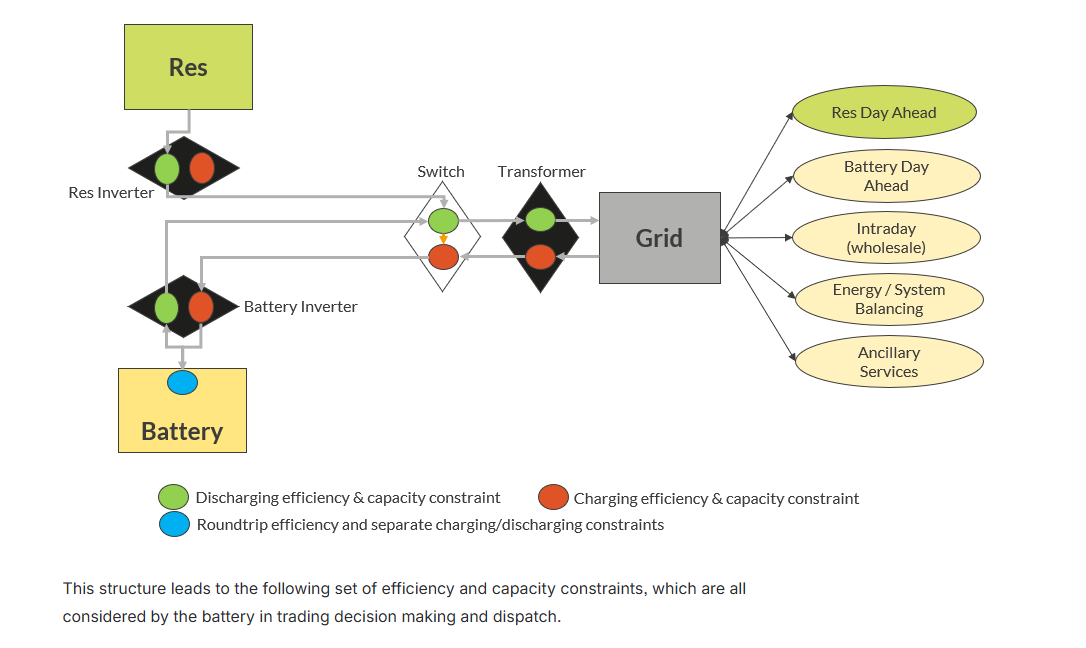
RES and Battery are separate assets, each with its own inverter. Power from RES to battery must pass through both inverters and the switch.
Constraints
| Battery | Res Asset | Res Inverter | Battery Inverter | Switch | Grid Transformer | |
|---|---|---|---|---|---|---|
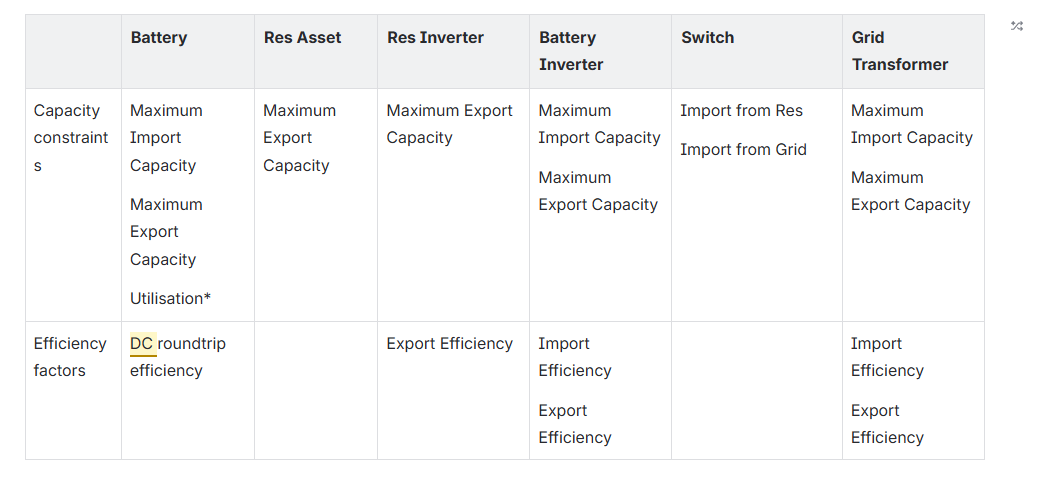
| Capacity constraints | Max Import, Max Export, Utilisation* | Max Export | Max Export | Max Import, Max Export | Import from Res, Import from Grid | Max Import, Max Export |
| Efficiency factors | DC roundtrip efficiency | — | Export Efficiency | Import Efficiency, Export Efficiency | — | Import Efficiency, Export Efficiency |
DC-Coupled Co-located Asset
The DC-coupled battery consists of a site with two assets (a battery and a RES asset) that share the same inverter. Energy from the RES stored in the battery does not pass through the inverter, but must pass through a DC-DC converter.
Components:
- DC Converter — a DC-to-DC converter, regulates voltage between the battery and the RES asset (necessary because RES voltage is not fixed). Subject to efficiency and capacity constraints.
- Shared Inverter — an inverter/rectifier pair shared by both assets. Subject to efficiency and capacity constraints applied to power flows from both assets.
- Grid Transformer — alters the AC voltage output so power can flow to/from the grid. Subject to both efficiency and capacity constraints.
- Switch — applies charging constraints (no grid charging / no RES charging).
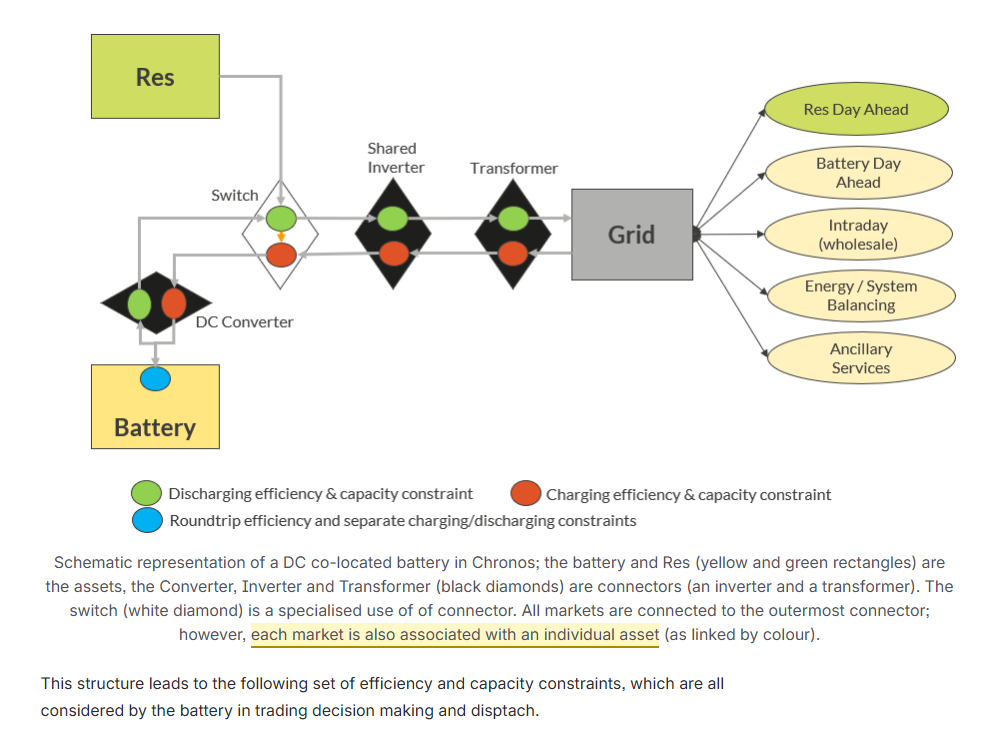
Battery and RES share the Inverter and Transformer (black diamonds). The switch (white diamond) is a specialised connector. Each market is also associated with an individual asset (linked by colour).
Constraints
| Battery | Res Asset | DC-DC Converter | Switch | Shared Inverter | Grid Transformer | |
|---|---|---|---|---|---|---|
| Capacity constraints | Max Import, Max Export, Utilisation* | Max Export | Max Import, Max Export | Import from Res, Import from Grid | Max Import, Max Export | Max Import, Max Export |
| Efficiency factors | DC roundtrip efficiency | — | Import Efficiency, Export Efficiency | — | Import Efficiency, Export Efficiency | Import Efficiency, Export Efficiency |
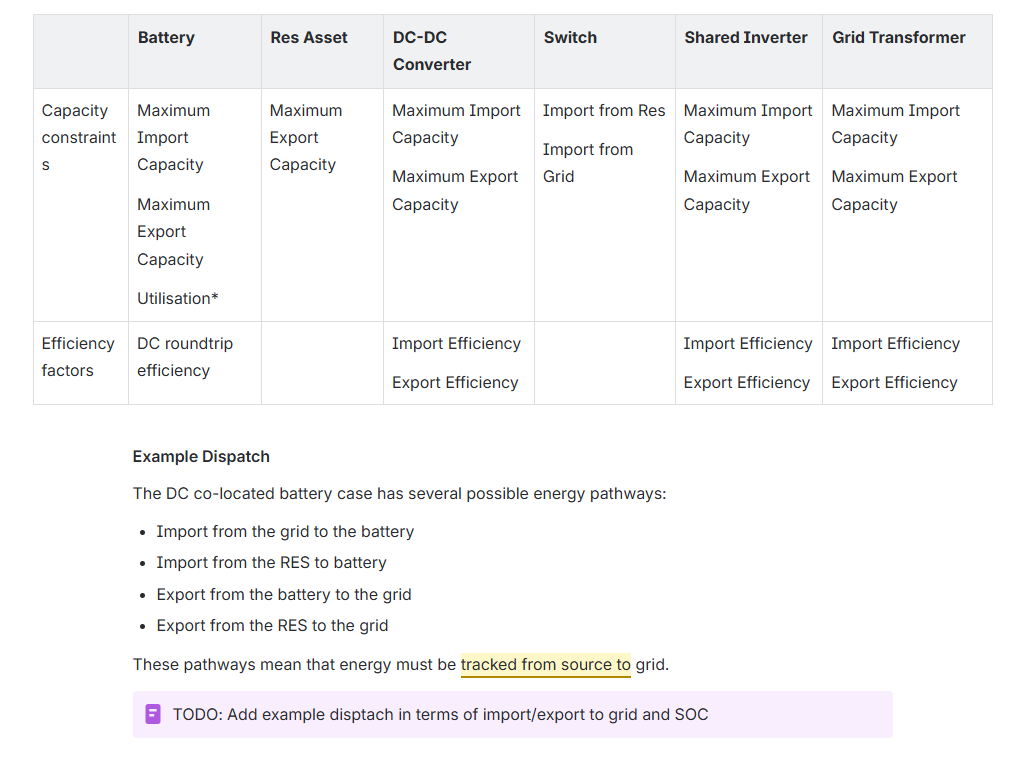
Example Dispatch — Energy Pathways:
The DC co-located battery has four possible energy pathways:
- Import from the grid to the battery
- Import from the RES to the battery
- Export from the battery to the grid
- Export from the RES to the grid
These pathways mean that energy must be tracked from source to grid.
Summary Comparison
| Standalone | AC-Coupled | DC-Coupled | |
|---|---|---|---|
| Assets | Battery only | Battery + RES (separate inverters) | Battery + RES (shared inverter) |
| RES → Battery path | N/A | Through both inverters + switch | Through DC-DC converter (bypasses inverter) |
| Key extra component | — | Res Inverter + Switch | DC Converter + Switch |
| Shared Inverter | No | No | Yes |
| Markets | Day Ahead, Intraday, Balancing, Ancillary Services | Res Day Ahead, Battery Day Ahead, Intraday, Energy/System Balancing, Ancillary Services | Res Day Ahead, Battery Day Ahead, Intraday, Energy/System Balancing, Ancillary Services |